- load testing
- k6
- alternatives
- comparison
7 Best k6 Alternatives for API Load Testing in 2026
k6 is a capable open-source load testing tool, and for a lot of teams it's a sensible default. But "sensible default" and "best tool for your job" aren't the same thing. Plenty of developers start a k6 evaluation, hit a wall (no GUI, no native GraphQL, dashboards behind k6 Cloud), and look elsewhere.
This is that "elsewhere" post. We rank six k6 alternatives in 2026 — Clobbr, Postman, JMeter, Artillery, Apache Bench, and Locust — on the dimensions we think actually matter for most teams: how fast you can run your first test, whether there's a UI, what happens to your data, and how painful the learning curve is. Stick around for the ending.
Upfront disclaimer: Clobbr is our product. We'll place it at #1 because we built it to solve the problems we kept hitting with the rest of the list, but we'll also tell you plainly where each of the other tools still wins. None of this is a benchmark race. In 2026, most API load testing tools are fast enough on a modern laptop. The differences that matter are UX, privacy, and how much ceremony sits between you and your first test run.
How we evaluated these tools
Every tool gets the same four-question treatment:
- Is there a GUI? For day-to-day exploratory load testing, a form beats writing a JavaScript scenario file every time. A GUI also makes it 10x easier to share a test setup with someone who isn't the author.
- Where does your data live? Some tools run locally and nothing leaves your machine. Others push runs, configs, and sometimes response bodies to a vendor cloud. This matters if your endpoints touch anything sensitive, or if your security team cares about third-party data processors.
- How long until your first test runs? Installation, configuration, first successful run. For a tool that's supposed to help you ship faster, this number should be measured in minutes, not hours.
- What's the learning curve? How many concepts between you and actually load testing an endpoint (Test Plans, Thread Groups, Samplers, virtual users, stages)? A tool that needs a day of onboarding had better be doing something the competition can't.
We don't cover pure RPS throughput on a specific workload. Every tool on this list can saturate a typical API. The bottleneck is your server, not the client.
1. Clobbr
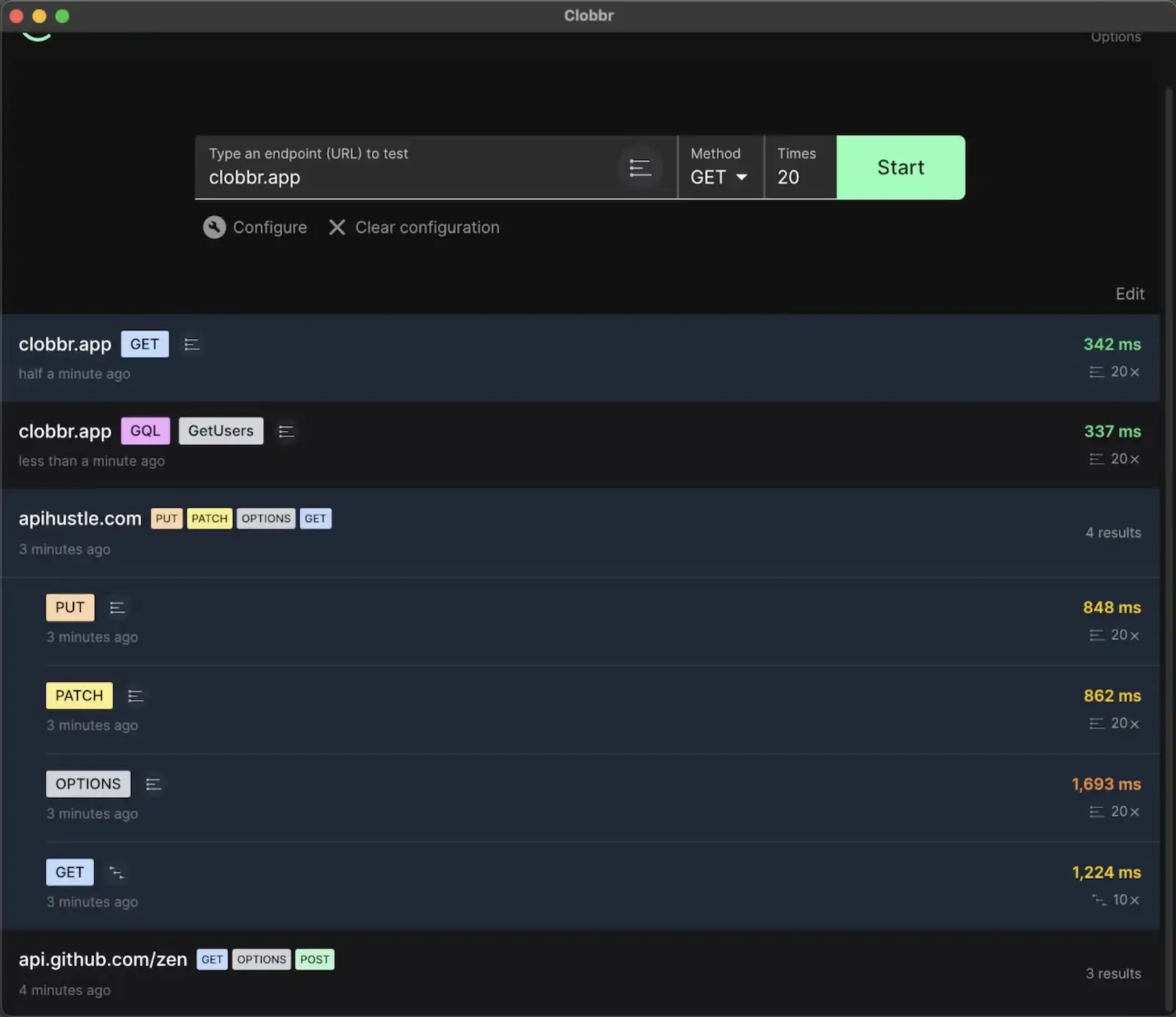
What it is. A native desktop app for macOS and Windows, plus a matching CLI on npm. Lifetime license, no subscription (free CLI, Included on Setapp). Built specifically for API load testing, not an API IDE with a load testing mode bolted on. Made by us, which is why it's here and why we're flagging that upfront.
Strengths. The UI is the point. Type a URL, pick a verb, paste headers and payload, run. First test takes under a minute. GraphQL is auto-detected and stats split per operation, so no manual POST wrangling. Result history is browsable across runs with charts and percentile breakdowns. Data never leaves your machine. The CLI takes the same config and exports CSV, JSON, or YAML for CI integration.
Weaknesses. Single-machine load generation, so you can't coordinate load from multiple geographic regions the way you can with k6 Cloud or JMeter's master/worker mode. No collaborative workspace (that's by design: no account required means no cloud sync). No Python / JavaScript scripting for complex scenarios; the model is "one request config, N iterations" plus small inline scripts for dynamic headers.
Pricing. Lifetime license for the desktop app (Mac App Store or Microsoft Store), no subscription. The CLI is free on npm. Included free in Setapp.
Best for. API developers testing their own endpoints. Small teams that want a consistent tool across GUI exploration and CI. Anyone who'd rather own software than rent it.
Dive deeper. Clobbr vs k6, Clobbr vs Postman, Clobbr vs JMeter, Clobbr vs Apache Bench.
2. Postman
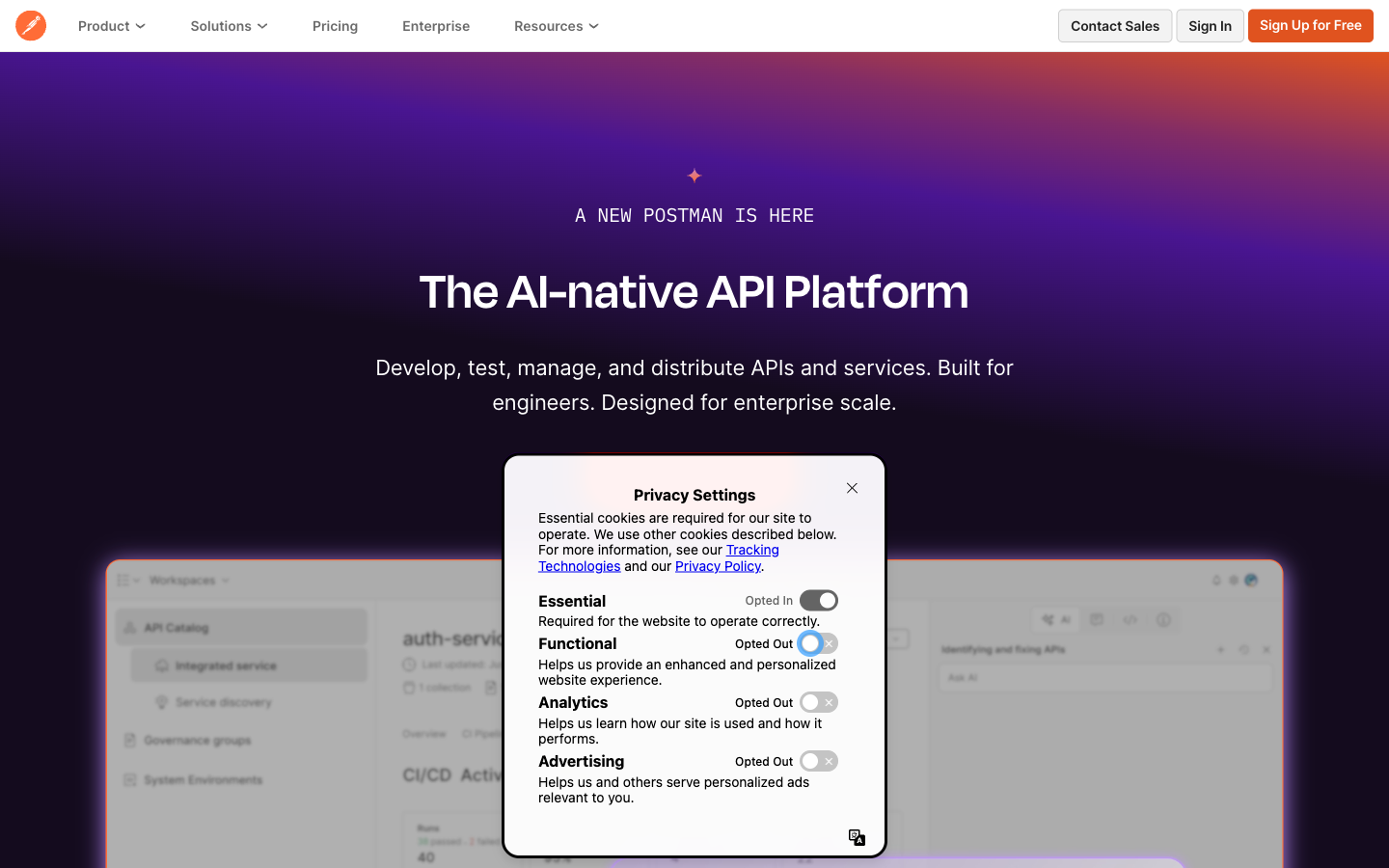
What it is. An API IDE with performance testing as one feature among many. Cross-platform Electron desktop app plus a web version, tied to Postman Cloud for collaboration.
Strengths. A genuine full-stack API tool: request authoring, schema design, mock servers, documentation, monitoring, and load testing in one place. Extensive collaboration features. Huge ecosystem of public APIs and shared collections. If your team already lives in Postman, running load tests from the same tool removes context switches.
Weaknesses. Load testing is a plan-gated feature: the free tier is limited in VUs and test minutes, and real usage requires a per-seat subscription. Cloud-by-default: your collections, environments, and credentials sync to Postman's servers when signed in. No automatic GraphQL detection for load tests; you set it up as a generic POST. Install footprint is heavy for a team that only wants load testing.
Pricing. Freemium with paid per-seat tiers. Performance testing sits in the paid tiers above a relatively low free-tier ceiling.
Best for. Teams where Postman is already the team's central API tool and collaboration matters more than purpose-built load testing features.
When Clobbr wins. When you want load testing without the subscription, the account, or the cloud sync. Single-purpose tools beat Swiss Army knives for the specific thing they're designed for. See our full Postman alternative comparison.
3. Apache JMeter
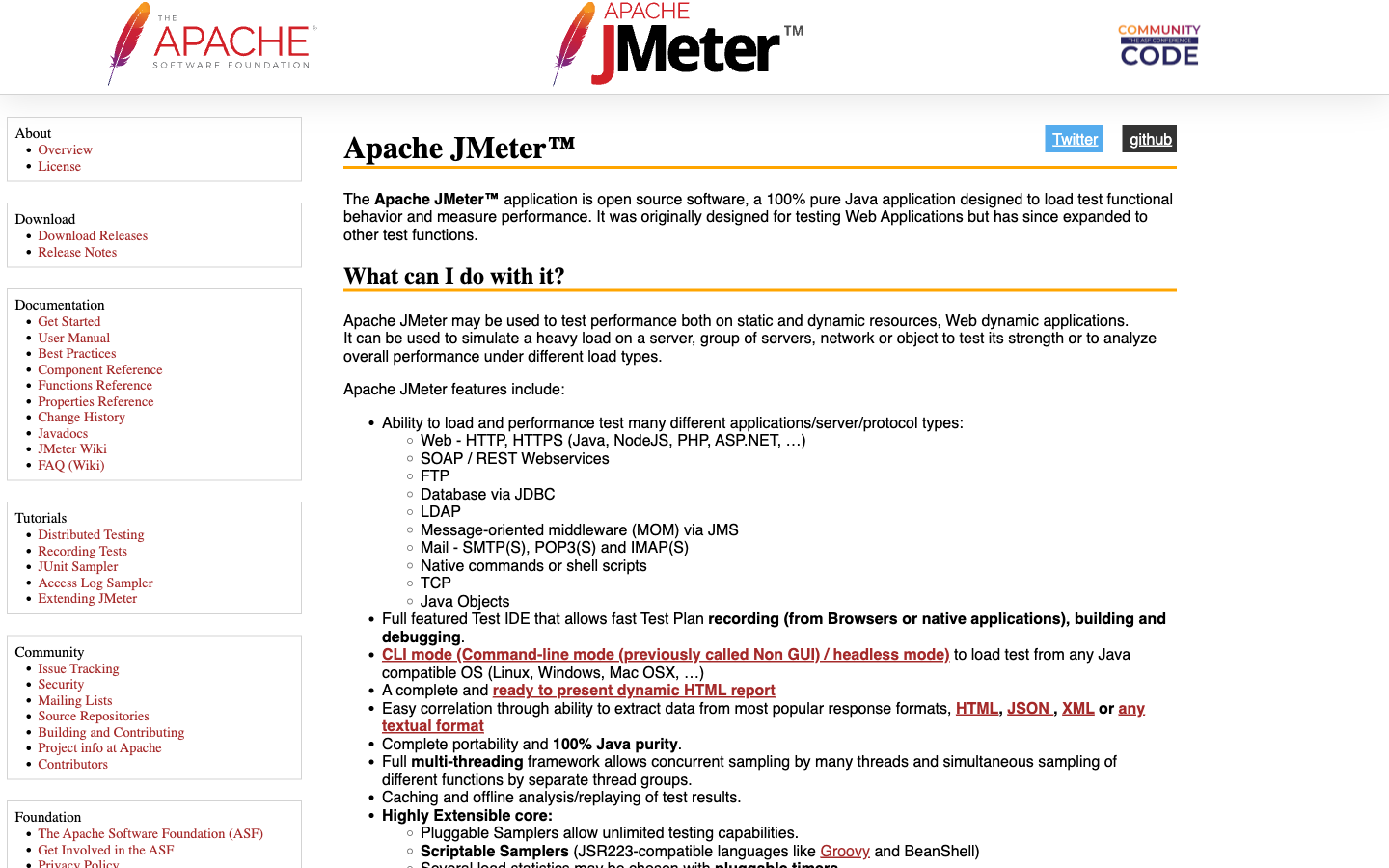
What it is. A long-running Apache Software Foundation project. Java desktop application with a tree-based Test Plan authoring experience. Supports HTTP, FTP, JDBC, JMS, SOAP, and more. Aimed at dedicated performance-testing teams.
Strengths. Mature, well-documented, free. Protocol coverage beyond HTTP is genuinely unmatched. Distributed load generation via master/worker mode. Huge library of plugins and listeners. If your organization has a performance-testing group, there's a reasonable chance they've standardized on JMeter already.
Weaknesses. JVM. You install a Java runtime first, then a several-hundred MB JMeter distribution, then start authoring a Test Plan. The tree-based model (Thread Group → HTTP Sampler → Listener → maybe a View Results Tree) is overkill for "hit this URL 500 times". Official guidance is that the GUI is for authoring, not for running load, meaning you design in GUI and run in CLI mode. No native GraphQL concept. No modern one-click share.
Pricing. Free and open source.
Best for. Dedicated QA / performance-testing teams. Tests that need distributed load from multiple coordinated machines. Scenarios covering non-HTTP protocols. Organizations that already have significant JMeter institutional knowledge.
When Clobbr wins. Every time an individual developer just wants to load test their own API. See our full JMeter alternative comparison.
4. Artillery
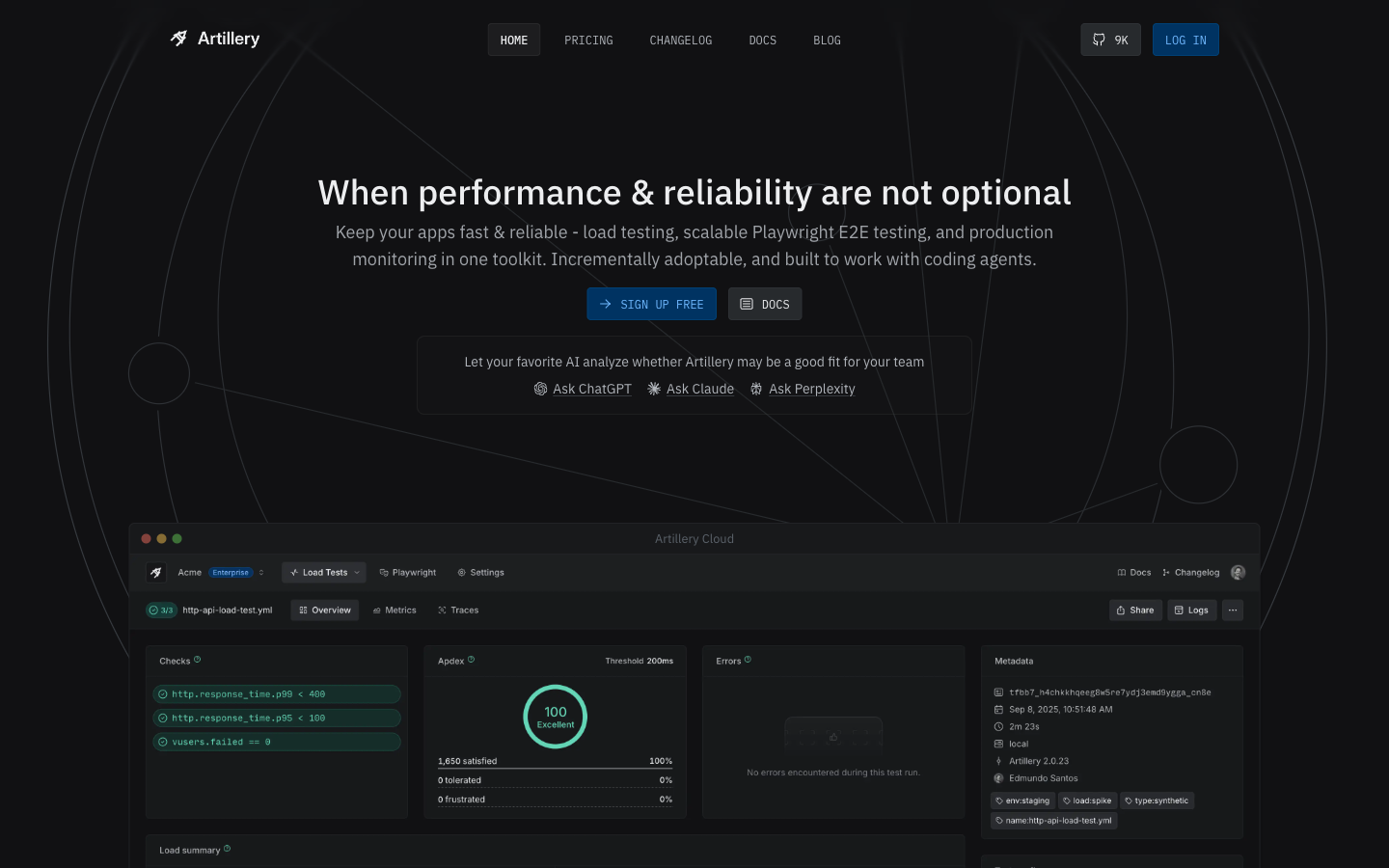
What it is. Node.js-based open-source CLI load tester. Tests are YAML scenarios. Artillery Cloud (a separate paid service) adds dashboards, Playwright-based end-to-end testing, and observability.
Strengths. YAML-based scenarios are more approachable than full JavaScript scripts for simple flows. Good modern CLI ergonomics. Decent Playwright integration if you want browser-level load testing. Active development and a thoughtful core team.
Weaknesses. CLI only, with the same "write a file, run it, read stdout" loop as k6. Dashboards and team features live in Artillery Cloud. GraphQL is just a POST with a body, same as everywhere else. Smaller community than k6 means fewer StackOverflow answers when you're stuck at 1 a.m.
Pricing. Artillery OSS is free. Artillery Cloud is a subscription with usage-based billing.
Best for. Small teams that like YAML configs, already use Node tooling, and want a lighter alternative to k6's JavaScript DSL.
When Clobbr wins. When you want a GUI, don't want to author a YAML file for every test, and would rather keep run history local than push it to Artillery Cloud.
5. Apache Bench (ab)
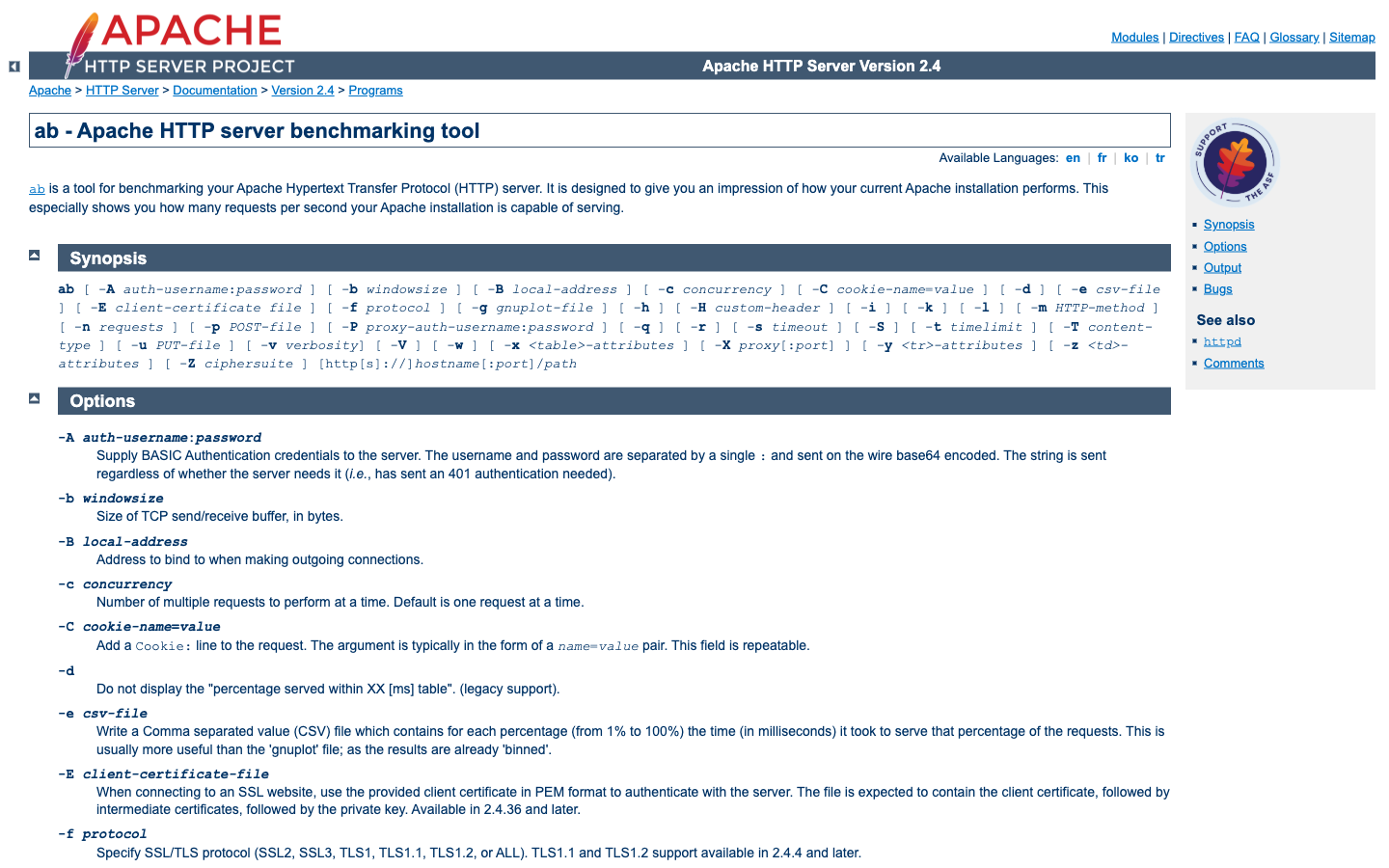
What it is. The oldest tool on this list. A single-binary CLI that ships with Apache HTTPD. Designed for benchmarking HTTP servers, particularly Apache HTTPD itself.
Strengths. Universally available on most Linux / macOS systems. Zero install on most servers. Tiny, fast, obvious for one-off smoke tests. If you need to know "does this URL return 200 under 1000 requests", ab gets you that answer in seconds.
Weaknesses. Everything else. Limited to GET and simple POST. Static headers only. No GraphQL concept. No result history, no charts, no modern export formats. Interpreting its output requires squinting. Getting it onto a Windows dev machine is awkward. Auth flows involving anything beyond Basic Auth or static tokens are out of scope.
Pricing. Free, bundled with Apache HTTPD.
Best for. Quick smoke tests on a public GET endpoint from a Linux server where ab is already installed. One-liner benchmarks embedded in shell scripts. Anywhere you'd rather not install anything new.
When Clobbr wins. As soon as your test involves JSON payloads, GraphQL, dynamic auth, or result history across runs. See our Apache Bench alternative comparison for the full breakdown.
6. Locust
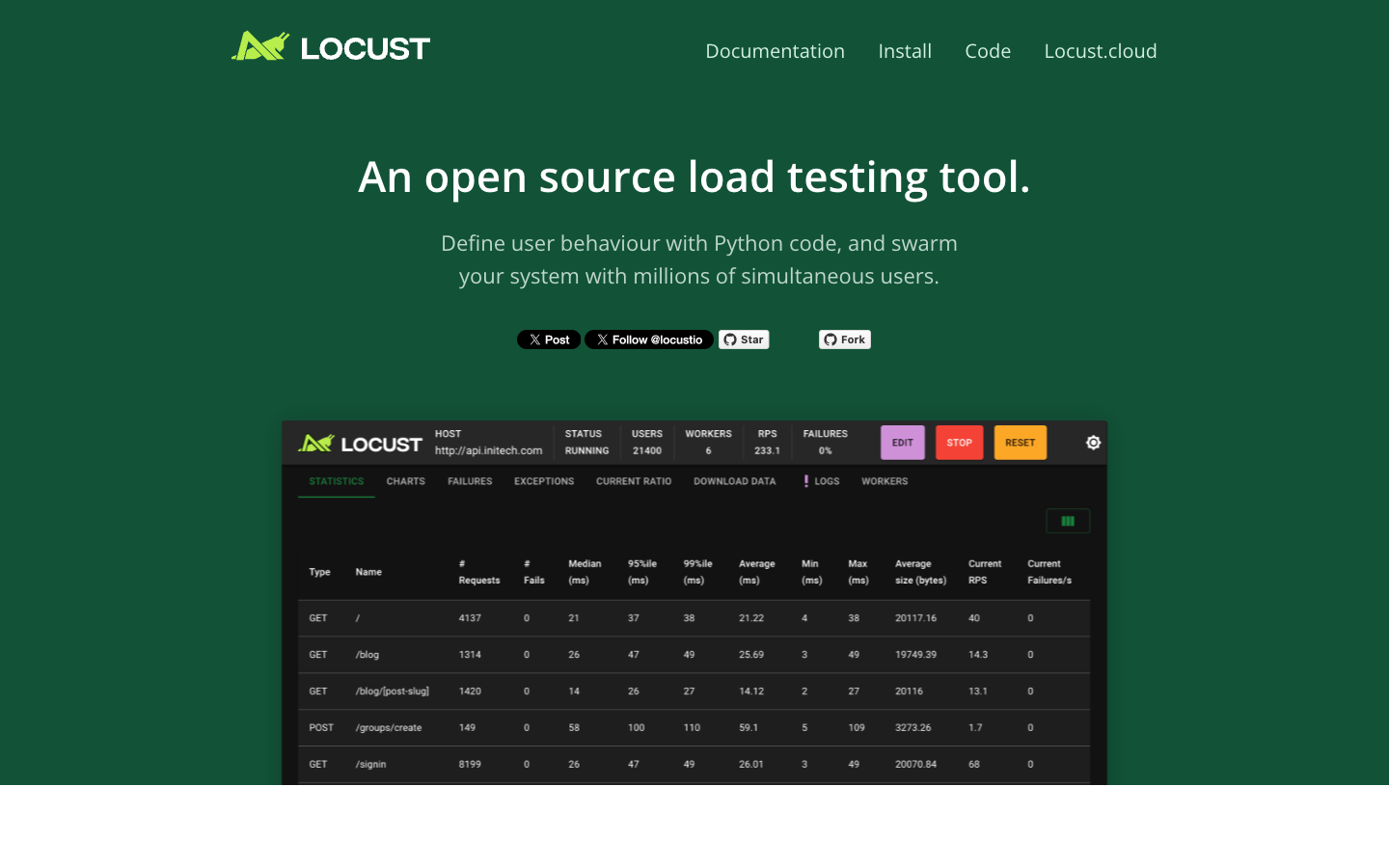
What it is. Open-source Python load testing framework. Tests are Python files defining user behavior. Includes a browser-based UI for monitoring running tests, a notable difference from most CLI-first competitors.
Strengths. Python. If your stack is Python, Locust plugs right in and lets you reuse fixtures, clients, and helpers. Distributed mode scales horizontally across worker processes. The live web UI for monitoring tests is genuinely useful: you can watch stats update during a long run.
Weaknesses. You're writing Python classes that subclass HttpUser and override on_start / @task methods. Onboarding for anyone not already in the Python ecosystem is a noticeable lift. The live UI is for monitoring, not authoring, so you still need a Python file to run any test. No native GraphQL concept. Reports are basic compared to commercial offerings.
Pricing. Free and open source (Locust.cloud exists as a separate paid service).
Best for. Python-first teams, especially ones already doing API development in Flask / FastAPI / Django. Anyone who wants open-source distributed load testing without k6 Cloud.
When Clobbr wins. Teams that aren't Python-first and don't want to become Python-first to run a load test.
7. k6 — the surprise pick
Surprise: k6 itself closes out this list. An honest "alternatives" post should admit when the incumbent is still the right call — and for a specific kind of team, it really is. Here's when to stop reading comparisons and just use k6.
What it is. An open-source CLI load tester originally from Load Impact, now part of Grafana Labs. Tests are JavaScript files with a k6-specific API. Bundles well with Grafana dashboards via k6 Cloud.
Strengths. Excellent scripting model for complex scenarios: stages, checks, thresholds, user iteration loops, custom metrics. First-class CI integration. Rich Prometheus / InfluxDB / Grafana exporters if you already live in that stack. Great community, mature docs, and a genuinely fun bundled runtime.
Weaknesses. CLI only. Every test is a JavaScript file you write, save, run, and read stdout for. Exploratory load testing becomes a context switch. Dashboards, run history, and shareable reports are k6 Cloud features, meaning a subscription and sending your runs to Grafana Cloud. GraphQL support is "here's a JSON body, write your own POST and parse the response yourself" territory.
Pricing. k6 OSS is free. k6 Cloud is a subscription with tiered VU-hour limits.
When k6 is still the right call. You already live in Grafana and want your load tests feeding the same dashboards as your production metrics. Your scenarios are genuinely stateful — conditional branching, correlated IDs pulled from previous responses, multi-step user journeys. A code-first, CI-native workflow is exactly what you want, and a GUI would slow you down. If any two of those are true, stop reading this list and go use k6. If you're still on the fence, Clobbr vs k6 walks through the head-to-head in more detail.
Quick comparison matrix
Scannable overview across the four dimensions we actually care about.
| Tool | GUI | Data location | Time to first test | Learning curve |
|---|---|---|---|---|
| Clobbr | Full desktop app | Local only | Minutes | Minutes |
| Postman | Electron + web | Postman Cloud (default) | 15–30 min | Low–medium |
| JMeter | Java GUI (author) | Local | 30–60+ min | Hours–days |
| Artillery | None (CLI) | Local (OSS); cloud (paid) | 20–30 min | Medium |
| Apache Bench | None (CLI) | Local | Under 5 min | Minimal (scope is minimal) |
| Locust | Web UI (runtime) | Local | 20–40 min | Medium (needs Python) |
| k6 | None (CLI) | Local (OSS); cloud (paid) | 30+ min | Hours |
How to pick
Simplify it to three questions:
- "Do I want a GUI?" If yes, your realistic list is Clobbr or Postman. Clobbr if your focus is load testing; Postman if you're already using it as your team's API IDE.
- "Do I need scripting for complex scenarios?" If yes, look at k6 or Artillery. JMeter if protocol coverage beyond HTTP matters. Locust if you're Python-first.
- "Do I just need a quick benchmark?" Apache Bench on a Linux box. Clobbr's CLI on anything else.
If you're not sure which bucket you're in, you're probably the first one. Start with a GUI, learn where your API actually hurts, and graduate to scripting only if a specific scenario demands it.
FAQ
Is k6 deprecated or being replaced by Grafana Cloud k6?
No. k6 OSS continues to be maintained. Grafana Cloud k6 is the commercial SaaS layered on top of it. You can run k6 OSS from your laptop or CI indefinitely, with or without a cloud account.
Can I run load tests without sending anything to a cloud service?
Yes. Clobbr and Apache Bench are local-only by design. k6, Artillery, JMeter, and Locust have OSS modes that don't require any cloud component, just know that signing up for their respective cloud products changes that. Postman defaults to syncing when signed in.
What about newer AI-based load testing tools?
Most of them are early and wrap one of the tools on this list (often k6) with a natural-language scenario builder. They're worth watching, but none have displaced the established tools for day-to-day load testing in 2026. If your case is genuinely complex enough that an AI-generated scenario helps, you're probably already in k6 or Artillery territory.
Do any of these tools support HTTP/3 or gRPC?
Coverage varies. k6 has solid gRPC support and experimental HTTP/3. JMeter needs plugins. Artillery has gRPC support. Clobbr is HTTP/1 and HTTP/2 focused today; gRPC is on the radar, not shipped.
Which tool is best for testing a GraphQL API specifically?
Clobbr. It auto-detects GraphQL and splits stats per operation, which none of the others do natively. Second best is Postman, which lets you explicitly mark a request as GraphQL in the API IDE side but treats it as a plain POST in load testing. See our GraphQL load testing use case for the full walkthrough.